
Our City Hall: Incumbent Track Records
Contents
This blog article includes incumbent voting records for Our City Hall’s 6 policy asks. Click to easily navigate to each policy ask section.
Housing Access AskPublic Transit & Mobility AskCommunity Spaces AskFood Security AskPublic Washrooms AskGender Safety AskFunding Our Policy AsksA few weeks ago, we shared the results of the Our City Hall Pledge, which called on Vancouver’s mayor and council candidates to commit to six community-backed policy asks if elected on October 17th.
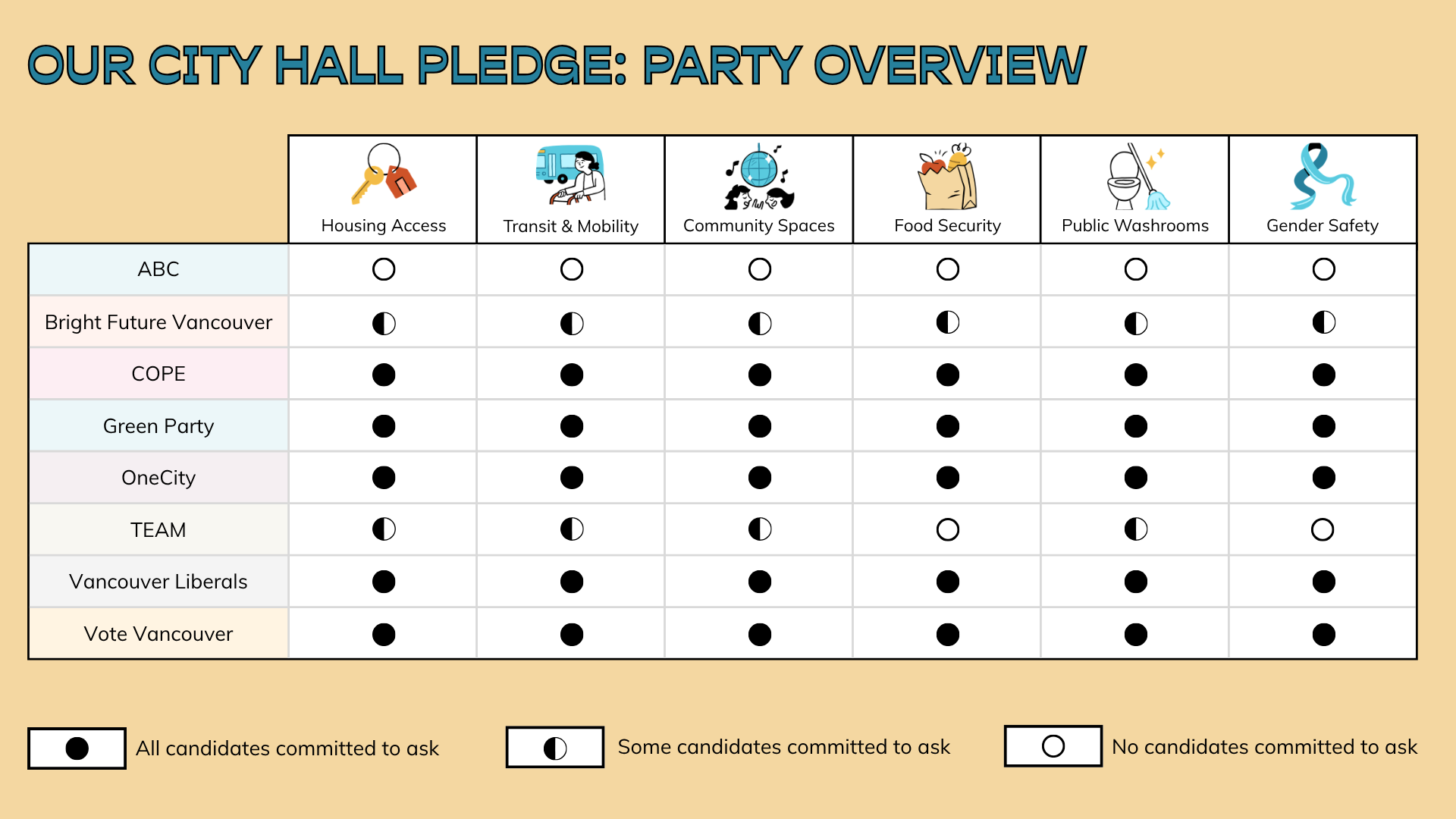
Election commitments matter, but they aren’t the only thing to consider when deciding which candidates we want to represent us. We can consider not only what candidates promise, but also how likely they are to follow through. When parties are running incumbents (a fancy word for someone who already holds elected office), one way to do this is to look at their past voting record.
We’ve compiled voting records on a handful of key decisions related to the Our City Hall's policy asks. Take a look below at whether incumbent parties have voted in line with our policy asks over the last few years.
Housing Access Ask
Will you commit to expanding access to non-market and climate-resilient housing options to reduce housing waitlist times, including:
Increasing co-op, social, and supportive housing in every neighbourhood by partnering with the non-market housing sector to proactively change zoning rules that delay non-market homes and make rents more expensive, within the first year of your term.
Prioritizing non-market housing on public land and demanding senior governments provide substantial, long-term funding to enable deeply affordable units.
Improving tenant safety during extreme heat by advancing building retrofit initiatives that provide low-carbon cooling, especially for low-income tenants.
Social Housing Initiative
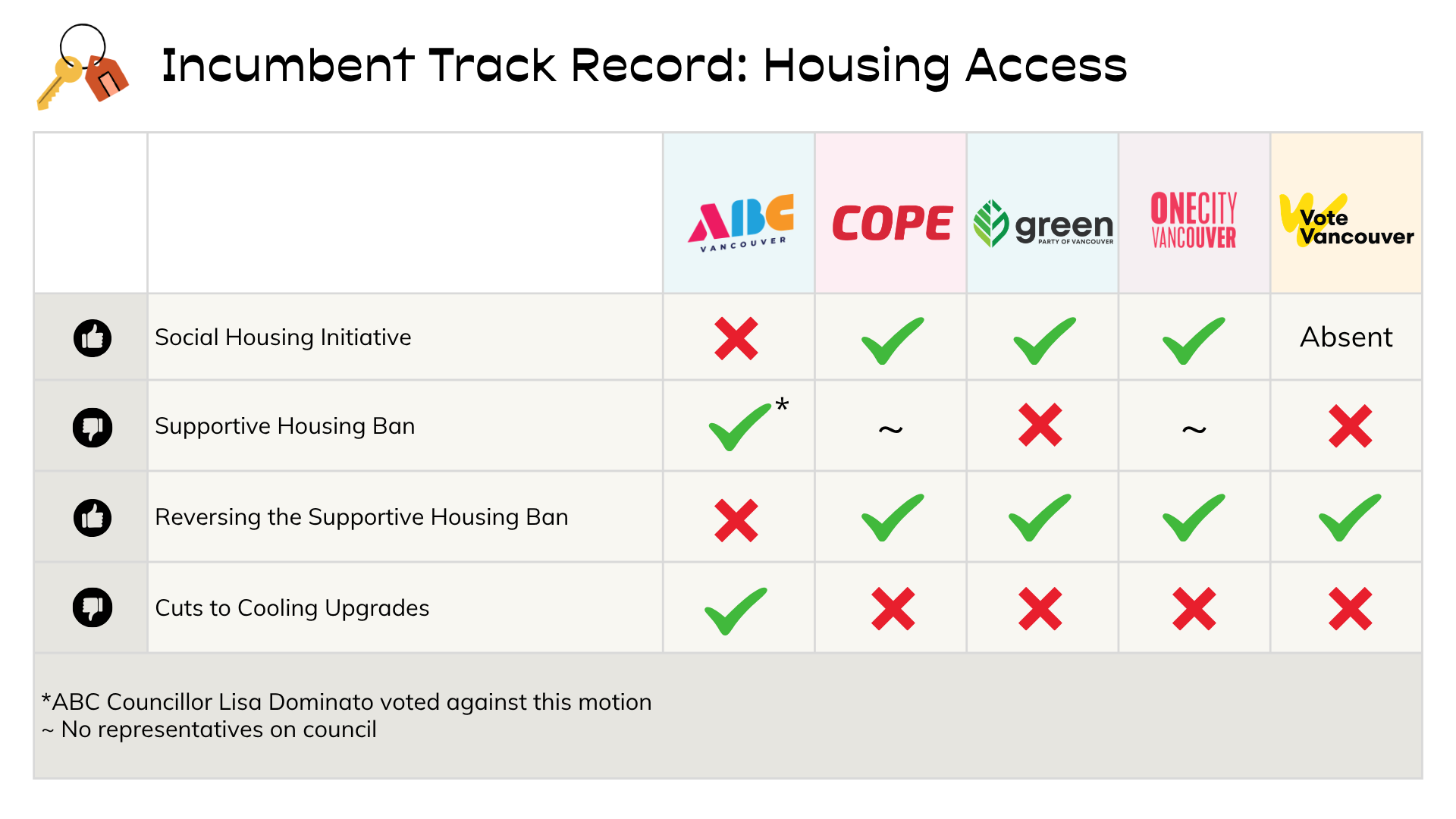
In December 2025, city council rejected a proposal to fast-track co-op, social, and supportive housing, despite strong backing from social housing providers. WTC supported this proposal, which took years to develop, because it would have made it easier to build the kind of housing we need most, at lower rents.
→ Green Party, and OneCity representatives voted in favour. ABC representatives voted in opposition. Vote Vancouver’s representative was absent.
Supportive Housing Ban
In February 2025, city council passed a partial ban on supportive housing on city-owned land. WTC opposed the supportive housing ban for many reasons, including the negative impact we anticipated this approach would have on Vancouver’s ability to secure much-needed funding for non-market housing from senior governments.
→ Green Party and Vote Vancouver representatives opposed this motion. ABC representatives voted in support, except for Councillor Lisa Dominato, who opposed it. COPE and OneCity did not have representatives elected to council at this time.
Reversing the Supportive Housing Ban
In April 2026, city council rejected a motion to end the ban on supportive housing and allow the city to allocate public land and funding to homelessness-response supportive housing. The motion stated that the city was losing out on federal housing funding because of the supportive housing ban.
→ COPE, Green Party, OneCity, and Vote Vancouver Representatives voted in favour of the motion. ABC representatives voted in opposition.
Cuts to Cooling Upgrades
During the 2026 annual budget proceedings, council passed an amendment to cut $8 million from programs designed to keep low-income tenants safer from extreme heat, smoke, and pollution. The funding would have supported building upgrades (also known as retrofits) to replace aging fossil-fuel heating systems with low-carbon electric systems that also provide cooling, which can save lives during extreme heat.
→ COPE, Green Party, OneCity, and Vote Vancouver representatives voted against the cuts. ABC representatives voted in favour.
Public Transit & Mobility Ask
Will you commit to making it easier, safer, and more accessible to move around the city, including:
Advocating to the province for a low-income transit pass for people earning less than $40,000 a year so that those who need the bus most aren't turned away.
Getting buses moving faster and more reliably by implementing transit-priority measures like dedicated bus lanes, with the goal of completing at least nine transit corridors by 2030.
Ensuring waiting for the bus is comfortable and safe by installing more covered bus shelters, seating, and lighting, especially in underresourced neighbourhoods.
Extending crosswalk times so that seniors, people with disabilities, and children have more time to cross the street, and, at the first opportunity, accelerating the installation of safe crossings, curb cuts, and sidewalk repairs.
Our friends at Movement and Vision Zero are across these issues! Check out Movement's transit report card, which covers city council’s track record on issues including bus priority lanes, low-income transit passes, and sidewalk investment. Look no further than Vision Zero’s report card, which tracks how city councillors have voted on road safety initiatives.
Community Spaces Ask
Will you commit to supporting free and low-cost gathering spaces, with priority investment in underserved areas, including:
Extending library hours and supporting the workers who maintain these spaces with adequate staffing and a living wage.
Increasing access to city-owned spaces by transparently reporting the number of underutilized properties and offering priority access and subsidized rent for community groups that facilitate social connection and address neighbourhood needs.
Working with independent arts and culture venues and queer spaces to reform permitting and bylaw barriers so they can sustainably run safe spaces.
Reinstating the Living Wage
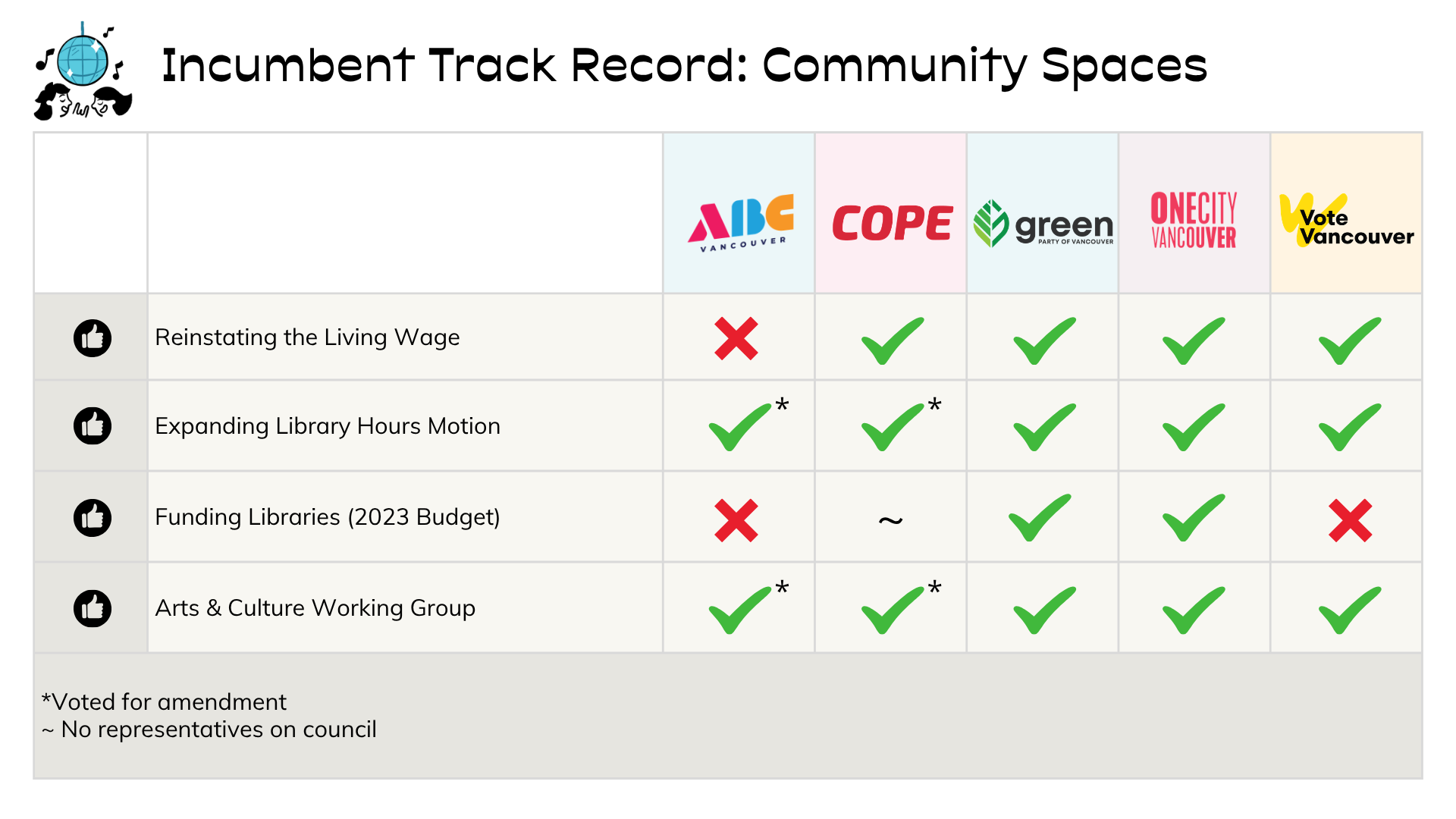
In 2023, Vancouver voted to end its living wage policy in a closed-door meeting. A January 2026 motion sought to reinstate the living wage for city workers, including library workers, who are mostly women and often earn less than male peers in other public sector industries with similar education.
→ COPE, Green Party, OneCity, and Vote Vancouver representatives voted in favour of the motion. ABC representatives voted against it.
Expanding Library Hours Motion
Last spring, several Vancouver Public Library branches had to reduce their hours and close on Mondays because of funding constraints. Council considered a motion to identify funding so that libraries can provide a free, safe, and welcoming place every day of the week. The motion passed unanimously. However, we shared the library worker union’s concerns about an amendment that blamed workers for the challenges libraries face without acknowledging chronic government underfunding of this essential public service.
→ All parties supported the motion. OneCity’s representative voted against the amendment. The Green Party’s representative abstained. ABC’s representatives and COPE’s representative voted in favour of the amendment. Vote Vancouver’s representative was absent.
Arts & Culture Working Group
Last summer, council considered a motion developed by the Arts and Culture Advisory Committee that put forward several recommendations to support the sector. While the motion passed, it was heavily amended to create an additional working group instead, which many from the arts and culture sector said was disappointing.
The working group formed and developed a memo for council with recommendations. In July 2026, council considered a motion to adopt these revised recommendations.
→ All parties supported the final motion. COPE, Green Party, OneCity, and Vote Vancouver representatives voted against the amendment to the initial motion that reduced its scope. ABC representatives voted in favour of the amendment.
Funding Libraries (2023 Budget)
During the 2023 annual budget proceedings, the Vancouver Public Library requested funding to extend hours at several branches and hire three social worker positions to support staff and patrons. Former OneCity councillor Christine Boyle moved an amendment to fund these requests.
→ OneCity and Green Party representatives voted in favour of the amendment. ABC and Vote Vancouver representatives voted against. COPE did not have a representative on council at this time.
Food Security Ask
Will you commit to improving access to affordable, culturally relevant, nutritious food, including:
Closing the gap in food system funding by increasing the existing Sustainable Food Systems Grant, expanding eligibility, and establishing a new Indigenous Food Sovereignty Grant, starting in the 2027 budget.
Providing city-owned real estate to establish a South Vancouver Community Food Hub offering services like affordable markets, food education, cultural food programming, kitchen access, and food recovery and distribution.
Directing the City Manager to create at least four food planner roles so the city has capacity for initiatives like equitable access to food retail, protecting cultural food businesses, food recovery, and advancing food sovereignty.
Closing the Gap Motion
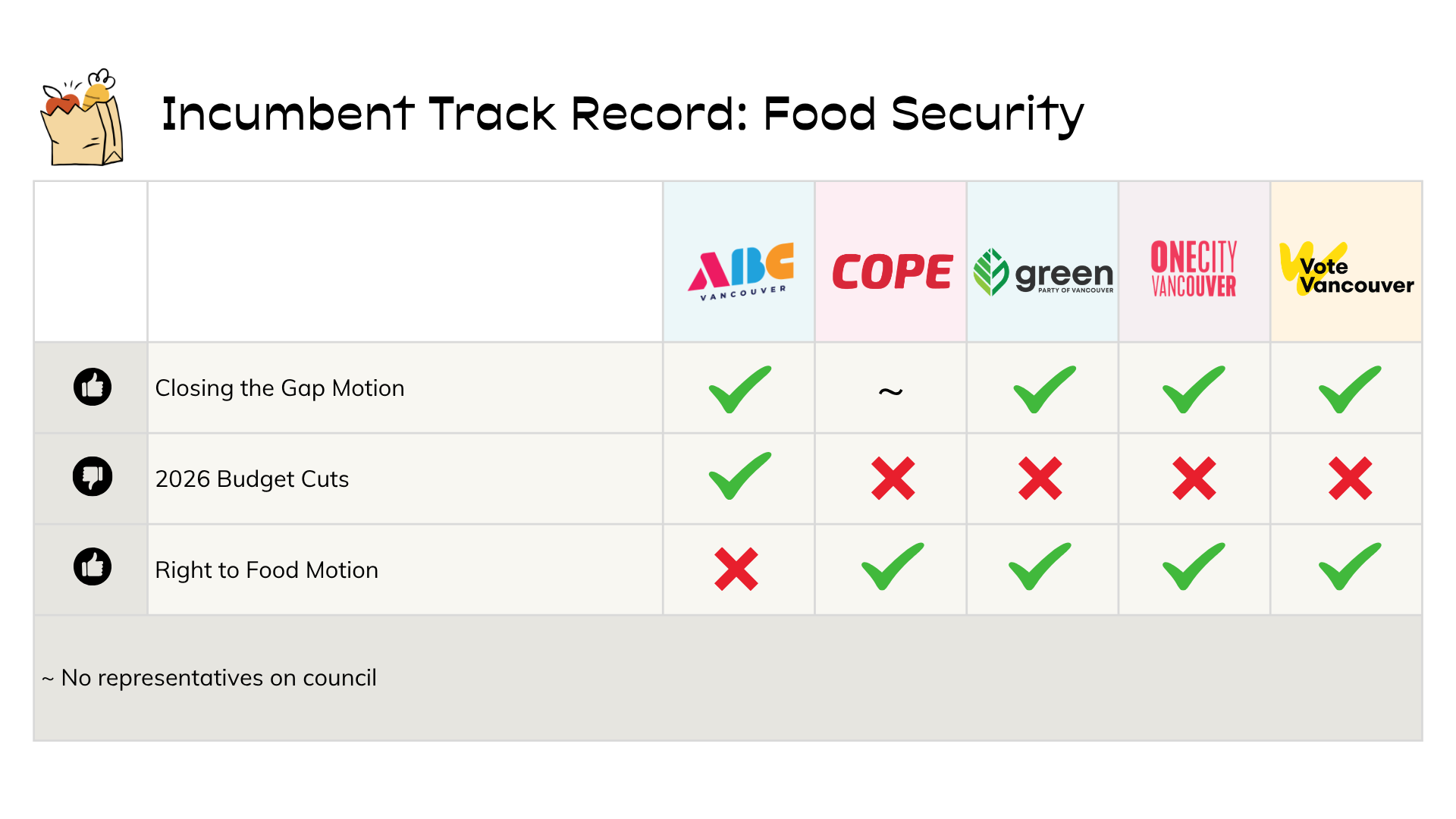
In July 2024, council unanimously passed a motion to explore measures to fund gaps in Vancouver’s food systems. The motion also directed staff to look into opportunities to use city-owned property for food non-profits.
→ All parties supported the motion. COPE did not have a representative on council at this time.
2026 Budget Cuts
The 2026 operating budget proposed $120 million in funding cuts, which inevitably resulted in decreased services and the loss of staff roles that help make life more affordable for those struggling most, including food security.
As the Vancouver Food Justice Coalition reported, “the City had four planners working on food. Shortly after the 2026 budget came into effect, three of the positions were eliminated.” The elimination of these roles is an unfortunate but unsurprising outcome of a budget that proposed significant cuts with no plan or transparency into what was being cut.
→ COPE, Green Party, OneCity, and Vote Vancouver representatives voted against the budget. ABC representatives voted in favour.
Right to Food Motion
In March 2026, council considered a motion to affirm “the human right to adequate, nutritious, safe, and culturally appropriate food as a guiding principle in City planning, land use, economic, and social policy decisions.” The motion also asked staff for a list of city-owned property located in food priority zones, options to pilot community operated grocery stores, and tools to protect culturally significant food retail.
→ COPE, Green Party, OneCity, and Vote Vancouver representatives voted in support of the motion. ABC representatives voted against it.
Public Washrooms Ask
Will you commit to addressing the gap in essential hygiene infrastructure by increasing the availability of accessible, maintained, 24/7 washrooms, including:
Installing prefabricated public toilets, like Portland Loos, in high-need areas, or setting up porta potties as a stopgap where needed.
Increasing funding for existing City and Park Board washroom maintenance and upgrades, especially in underresourced neighbourhoods.
Partnering with DTES service providers and other levels of government to sustain and expand peer-and non-profit-supported hygiene facilities such as mobile washrooms, staffed washrooms, showers, and laundry facilities, with safer options for women and gender-diverse people.
Places to Go Motion
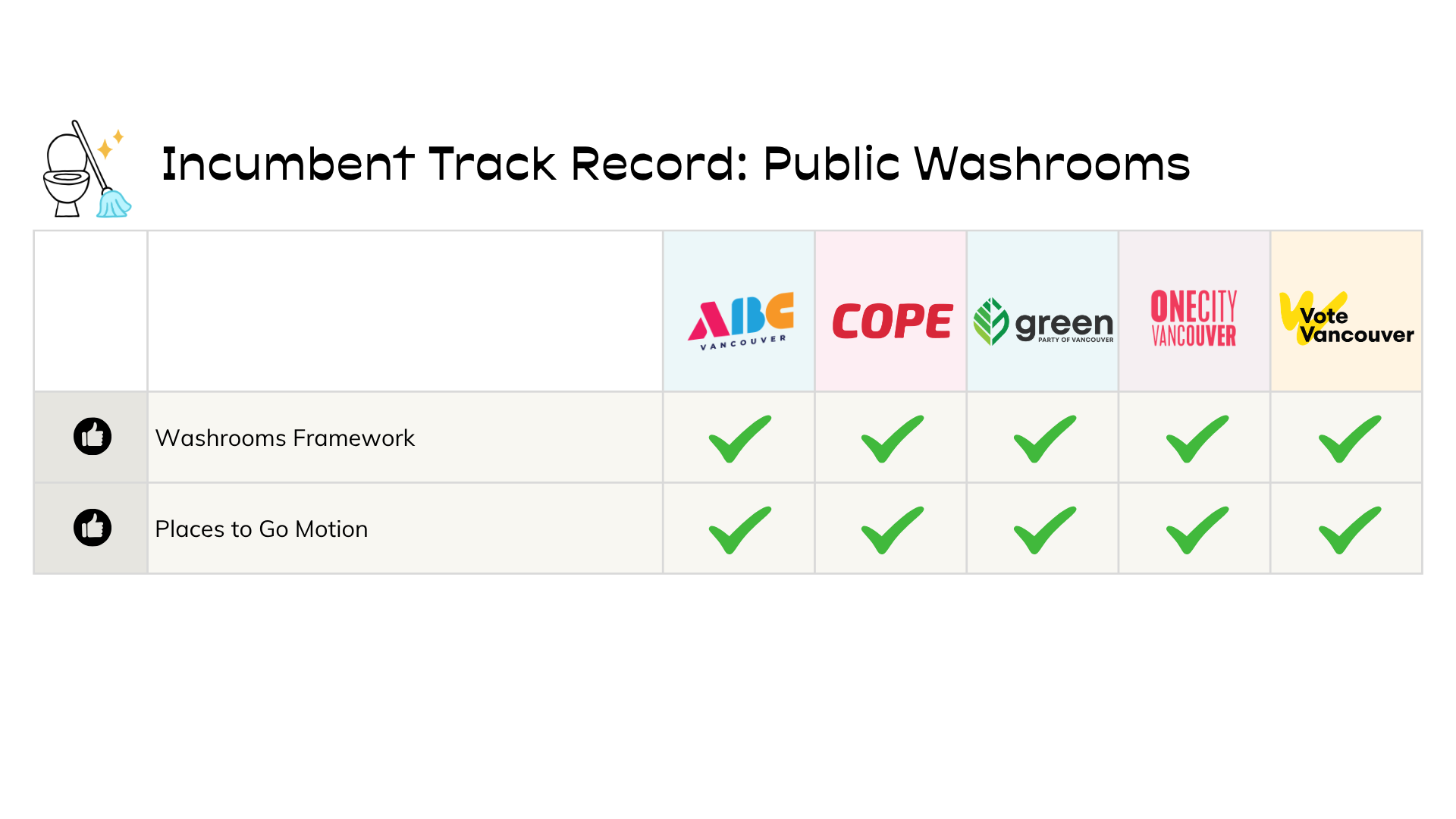
In May, council considered a motion to identify and address gaps in accessible, well-maintained washroom access across the city, as well as to improve access to day-time drop in shelters.
→ All parties voted in favour of the motion.
Washrooms Framework
In January, council voted on a staff report “aimed at making public washrooms easier to find, maintain and more evenly distributed across the city.” The report included several important measures, like installing more Portland Loos following a pilot in a few downtown locations. The Washrooms Strategic Framework is an important first step it doesn’t act with the urgency needed to address this public health risk.
→ All parties voted in favour of the report.
Gender Safety Ask
Will you commit to centring gender equity in safety planning, including:
Funding the city's work to implement the MMIWG2S+ Calls for Justice and Red Women Rising recommendations.
Supporting the rights, safety, and dignity of sex workers by reinstating the second Sex Worker Safety Planner role and ensuring drop-in spaces for sex workers receive sustainable funding.
Ensuring the timely implementation of survivor-led safety and violence prevention strategies, including the 2STGD+ Safety and Inclusion Action Plan.
2STGD+ Safety & Inclusion Action Plan
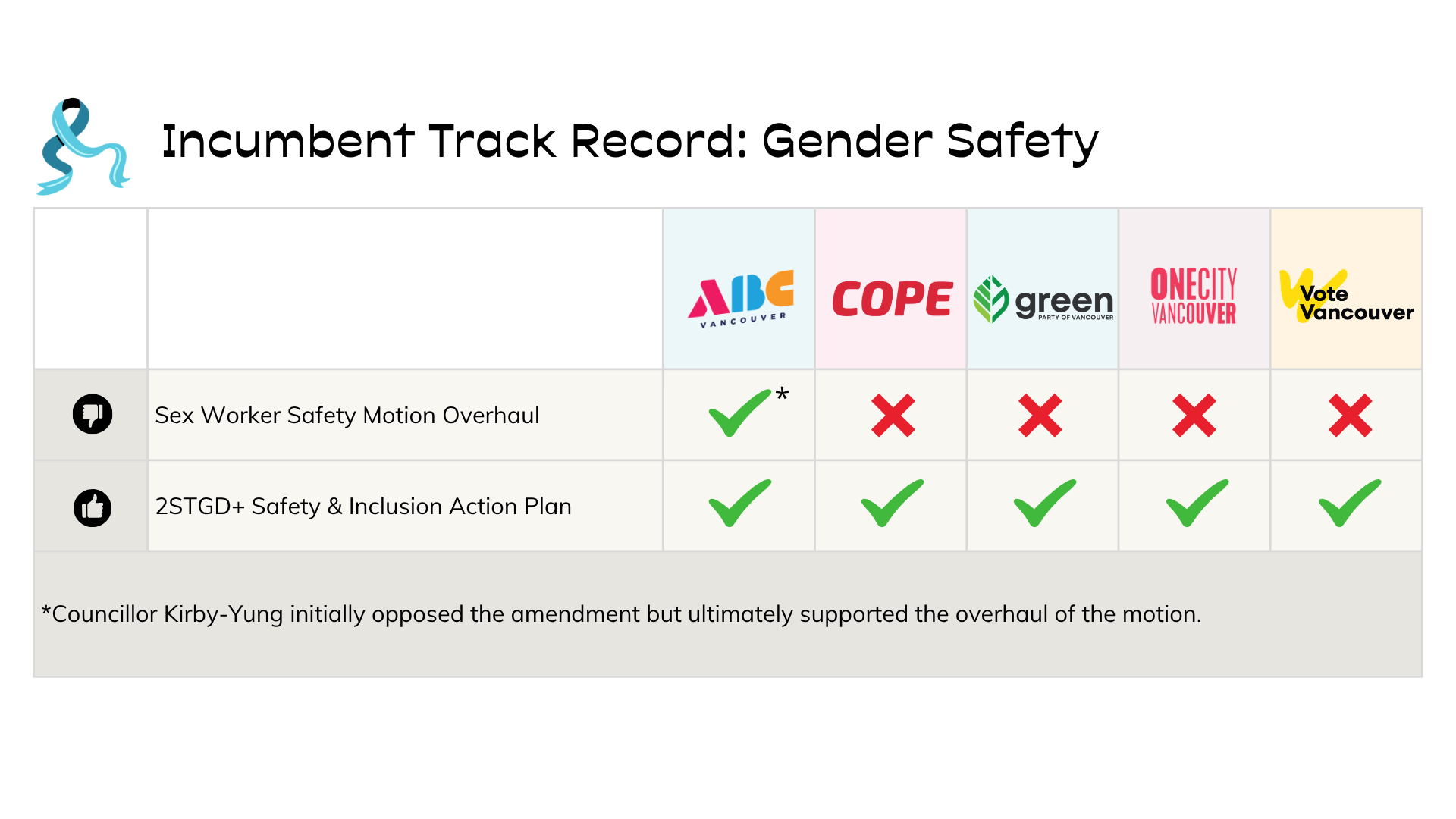
In February, council approved an updated 2STGD+ Safety and Inclusion Action Plan that lays out how Vancouver will improve equity, safety, and well-being for Two-Spirit, transgender, and gender diverse (2STGD+) people, focusing on housing and homelessness, community spaces, tailored services, representation and engagement, and an inclusive workplace.
→ All parties voted in favour of the report.
Sex Worker Safety Motion Overhaul
As a result of council’s 2026 budget cuts, Vancouver went from having two Sex Worker Safety Planners to one. As we wrote in our letter to council, “eliminating this position leaves a critical gap in the City's ability to plan for and respond to sex workers' rights, health, and safety concerns.”
In May, council considered a motion to reinstate this role and take other measures to understand and support the rights, safety, and dignity of sex workers. Councillor Dominato moved an amendment that removed much of the original motion, including the commitment to reinstate the second Sex Worker Safety Planner. As the Georgia Straight reported, “to say [the amendment] watered the original motion down would be an understatement. It drowned the thing.”
→ COPE, Green Party, OneCity, and Vote Vancouver representatives voted against the overhaul amendment. ABC representatives voted in favour (with the exception of Councillor Kirby-Yung who opposed the initial amendment but voted in support of the heavily amended clauses of the motion).
Funding Our Policy Asks
Motions matter, but funding shows what our leaders value. That’s why, in the Our City Hall Pledge, we also asked candidates:
“Do you acknowledge that part of committing to these policy asks includes ensuring each policy area you commit to receives sufficient funding in operating and capital budgets, including modest increases to the annual property tax rate if needed?”
An important part of analysing incumbents’ track records is looking at whether their voting record and statements match what they choose to put resources behind. Budgets determine whether approved projects actually get off the ground and how quickly they’re completed.
WTC was concerned about a lack of transparency in the 2026 budget and significant cuts to many of the priorities community members told us about during the Our City Hall Campaign.
→ COPE, OneCity, Green, and Vote Vancouver representatives opposed the 2026 budget cuts. ABC moved and voted in favour of them.
